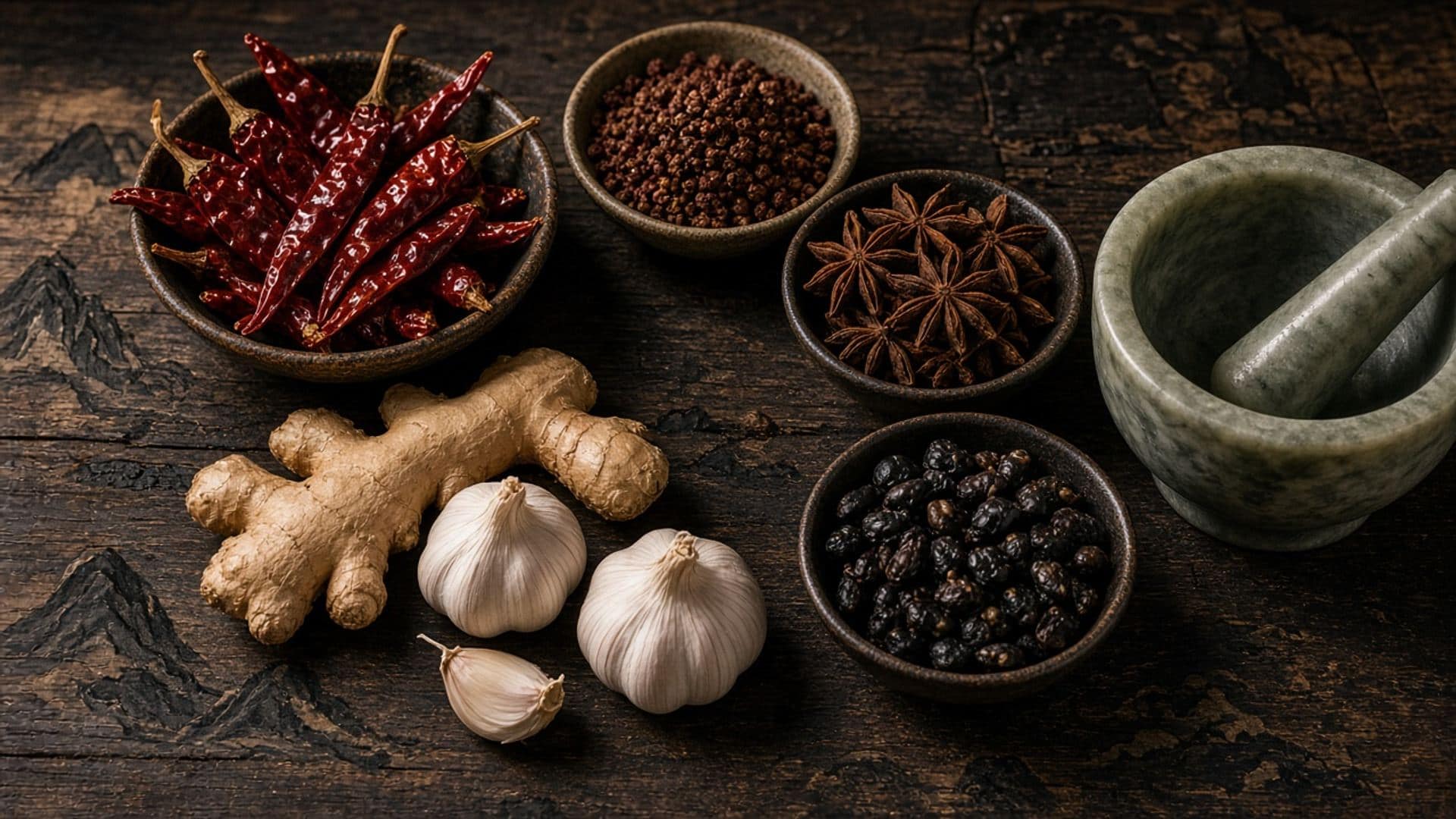
“Chinese food” on an Australian awning is a headline, not a cuisine. China is a continent of kitchens. The useful question in a restaurant is which one you have walked into — or whether you have walked into an Australian-Chinese room that stopped trying to be a single province decades ago.
This page stays with differences you can taste and see. It does not rank regions. It does not pretend a suburban mixed menu is a failure. It does give you language for the pantry, the heat and the starch so you can order on purpose.
Cantonese: the historic Australian default
Cantonese cooking, from Guangdong and the Pearl River Delta, is the foundation of most older Australian Chinese restaurants. It is a wok cuisine and a roast cuisine. The wok is driven hard so vegetables stay vivid and proteins pick up wok hei — the faint scorched-breath flavour of a carbon-steel pan over serious flame. Roasts — duck, pork belly, soy chicken, char siu — are hung, chopped and served with a sharp knife and a dish of sauce.
Seasoning is not shy, but it is not built on dried chili. Soy, ginger, spring onion, garlic, oyster sauce, fermented black beans and stock do the work. Seafood is steamed more often than deep-fried when the kitchen is confident. Yum cha — the tea-and-dumpling brunch — is a Cantonese civic form that Australia adopted wholesale.
If a room is Cantonese on purpose, the roast display, the steamer baskets and a short list of green vegetables cooked in raging heat are better clues than a paragraph on the specials board.
Sichuan: mala, pickle, and layered heat
Sichuan cooking is famous for ma (the citrus-tinged numbness of Sichuan pepper) and la (chili heat), but the kitchen is broader than a chili-oil jug. Pickled mustard greens, chili-bean paste (doubanjiang), garlic, ginger and a lot of oil as a carrier of flavour are the other pillars. Dishes can be dry-fried, water-cooked in a brothy chili bath, or piled under a hill of dry chili that you are not expected to eat pod by pod.
Mapo tofu, twice-cooked pork, fish-fragrant eggplant (the “fish-fragrant” is a pickle-garlic-sugar-vinegar profile, not seafood) and dan dan noodles are the dishes most Australian menus borrow. A kitchen that is actually Sichuan will usually have a wider pickle and offal list, and will not sweeten everything to protect you.
Heat is adjustable if you ask. “Not spicy” in a Sichuan room still may not be mild by a Cantonese measure. Be specific: no dried chili, or less oil, or no Sichuan pepper.
Shanghainese and Jiangnan: soy, sugar, vinegar, river fish
Shanghai sits in the Jiangnan / Yangtze delta world: rice, river fish, pork, and a seasoning balance that reads sweeter to diners used to Cantonese salt or Sichuan heat. Dark soy, rock sugar, Shaoxing wine and Chinkiang vinegar show up in red-braises, drunken chicken, lion’s head meatballs and sweet-sour ribs that are not the same as the Australian sweet-and-sour pork of the 1970s.
Xiaolongbao — soup dumplings — are the dish people travel for. They are a technique problem (thin skin, hot stock, vinegar and ginger) more than a spice problem. If a room advertises them, watch whether they arrive pleated and seated, or sodden.
A Jiangnan menu that also offers mapo tofu and satay kangaroo is telling you it is a mixed room. That is fine. Order the red-braise and the dumplings, not the whole atlas.
Hakka and Teochew: the other south
Hakka cooking is the food of a migrant people inside China as well as outside it. Salt-baked chicken, stuffed tofu, preserved vegetables and a fondness for hearty braises are typical markers. Teochew (Chaozhou) cooking, from eastern Guangdong, is lighter, with a precise hand on seafood, rice porridge, cold crab and a dipping-sauce culture.
Both appear in Australian cities more often than they are labelled. If you see “salt baked”, “steamed fish with salted vegetable”, or a porridge-and-small-plates logic, you may be closer to Teochew than to generic Cantonese even if the awning does not say so.
Hunan, Beijing, and the north-west
Hunan heat is different from Sichuan: more fresh chili and smoke, less of the tingling pepper, often dryer. Beijing and the broader north eat more wheat. Dumplings, noodles, pancakes and breads share the table with dishes that can be heavier on garlic, leek and brown sauce. Peking duck is the celebrity export; it is a specialised roast-and-pancake service, not a midweek stir-fry.
Xinjiang and other north-western Muslim Chinese kitchens bring lamb, cumin, bread and skewers. In Australian cities these rooms sometimes sit slightly apart from the “Chinese restaurant” category, which is a diner habit, not a culinary truth.
Australian-Chinese: a local region
Honey chicken, dim sims, chop suey histories, banana fritter, the banquet of spring rolls plus fried rice plus sweet-sour — these are not errors. They are a local canon formed when Cantonese cooks fed people who wanted familiarity, crunch and a little sugar. Melbourne’s dim sim, in particular, is a Chinese-Australian snack with its own shape and breadcrumb-or-pastry arguments. Treat this food with the same seriousness you would treat a good suburban roast. It has rules. A soggy dim sim and a crisp one are not the same dish.
The mistake is to use Australian-Chinese as a slur for any room that is not a provincial specialist, or to use “authentic” as a slur for any room that is. Read the menu. See if it has a centre of gravity.
How to use this on a night out
Decide the region before you decide the hero dish. If the table wants mala, do not also insist on a delicate steamed coral trout in the same tiny kitchen unless the room is set up for both. If the table wants yum cha, you are in a Cantonese form even when the cart includes a fusion dumpling.
For home cooking, pick one pantry and stay there for the hour. The recipes on this site are written that way: tomato and egg as a home Cantonese-adjacent staple, mapo-style tofu as a Sichuan-leaning weeknight, steamed fish as a southern technique. Mixing chili-bean paste into a ginger-scallion fish is how you get a confused plate.
Chinese restaurant dining in Australia is richer for the pile-up of regions. You do not have to eat all of them in one night.
Sauces that tell you the region
You can often name the kitchen from the sauce tray before the first plate lands.
Cantonese tables lean to light soy, chili oil that is optional, Worcestershire in older Australian-Chinese rooms, and a mustard or ginger dip for roast. Sichuan tables put chili oil, vinegar and ground Sichuan pepper within reach because the dishes expect you to finish the seasoning. Shanghainese and Jiangnan rooms may bring Zhenjiang vinegar and ginger for dumplings as a default, not a novelty. Northern dumpling rooms will look under-dressed without black vinegar.
If the tray is a generic sweet chili from a bottle and nothing else, you are probably in a mixed tourist menu. That is information, not a moral failure.
Rice versus wheat
South of the Huai River, rice is the daily starch. North, wheat takes more of the load: dumplings, noodles, pancakes, breads. Australian restaurants blur this because rice is expected by diners who grew up on Australian-Chinese banquets. You can still see the original logic. A Beijing-style room that only offers fried rice has already compromised for the postcode. A Cantonese room with a dumpling list may be filling a gap, not claiming the north.
When you cook at home, pick the starch that matches the sauce. Mapo tofu wants rice. A cumin lamb wants bread or a thick noodle. Sweet-sour pork with both fried rice and fried noodles is how a table gets tired.
Tea as a regional tell
Oolong and pu-erh sit more naturally with greasy roast and yum cha. Jasmine is the Australian default because it is floral and familiar. Chrysanthemum is offered as a cooler, especially in warmer rooms. None of this is a test you can fail. It is a way to notice that the house made a choice. If the only option is a tea bag in a pot of water that never came to the right heat, notice that too.
What “fusion” is doing
Some Australian rooms cook a deliberate hybrid: a Sichuan pepper prawn next to a native-lime something, a dumpling with a local cheese that should have stayed in another restaurant. Judge those plates as inventions. The question is whether they are composed, not whether a grandmother in Chengdu would recognise them. The regional map on this page exists so you can tell invention from confusion.
Confusion is a menu that cannot decide. Invention is a short list that knows what it borrowed.
Allergies do not respect regions
Wheat, soy, shellfish, sesame, egg and peanut cross every provincial border. A Teochew steamed fish can be a safer gluten conversation than a northern noodle. A vegetarian Sichuan dish can still be built on fermented paste processed with wheat. The food guide is the practical page. This essay only warns you not to use “authentic” as a substitute for an ingredient question.
Chinese cooking in Australia will keep adding kitchens. Xinjiang, Yunnan, Dongbei and others already sit in the larger cities more often than older diners expect. When a new regional word appears on an awning, come back to the same questions: what is the starch, what is the heat, what is the pickle, what is the fish doing? The map is a method, not a closed set.