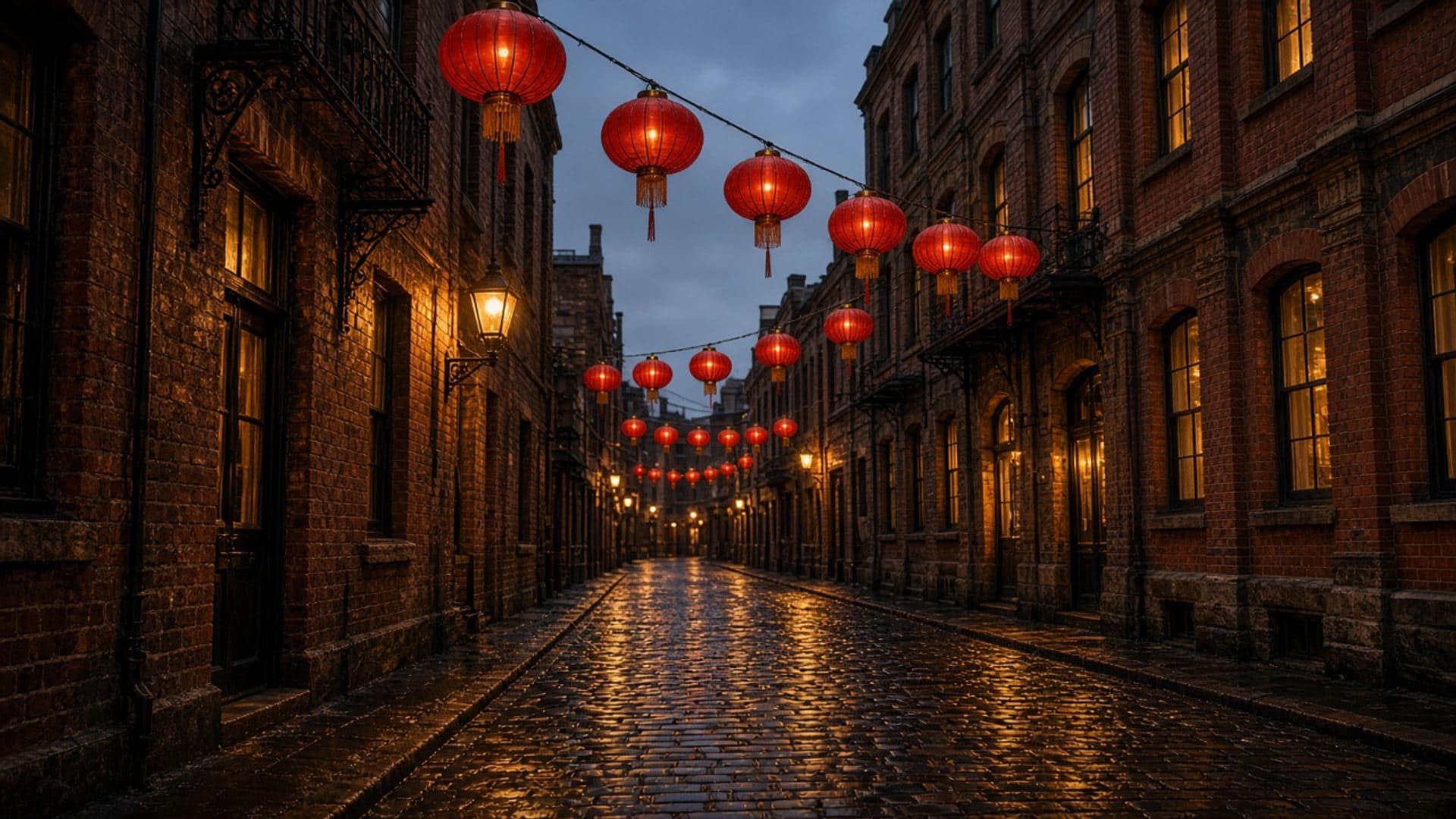
Melbourne’s Chinatown is a working street with a long memory. It is not a festival set that appears in February and vanishes. Little Bourke Street between Swanston and Spring has held Chinese businesses, clan associations, newspapers, boarding houses and kitchens since the Victorian gold rush. Public histories describe it as the oldest continuous Chinese settlement in the Southern Hemisphere. That continuity is the point of this guide.
What you see now is a compressed, lantern-strung, heritage-layered precinct inside the Hoddle Grid. What you should not expect from this page is a roster of rooms that are definitely open on the day you visit. Kitchens turn over. This site does not list operators or invent opening hours. Walk the street, read a menu, and decide.
Gold, southern China, and a city lane
Chinese migration to the Port Phillip District rose sharply after gold was found in 1851. Most of the early arrivals came from southern counties in Guangdong. They worked the fields, then the supporting trades of a boom city: stores, lodging, market gardens, furniture, laundries, and food. Little Bourke Street — already a narrower, cheaper, service lane behind the grand Bourke Street frontage — became the address where those trades clustered.
The clustering was practical and defensive. English-language Melbourne was often hostile. The later White Australia framework made Chinese life in the city narrower still. Associations, temples and newspapers mattered because they were infrastructure: a place to send money, find a bed, settle a dispute, bury someone properly. Food businesses sat inside that civic fabric, not outside it as “restaurants” in the later tourist sense.
By the late nineteenth century the street was already a destination for non-Chinese Melburnians as well as a home street. That double life — community spine and public attraction — has never quite gone away. It is why the arches, lanterns and festival calendar sit on top of ordinary weekday trade.
How the precinct is laid out
Think of Chinatown as a short east–west spine with north–south slips. Little Bourke Street is the spine. Swanston Street is the western approach most visitors use; Spring Street and the Parliament end close the eastern run. Cohen Place opens off the street toward the Museum of Chinese Australian History, a useful civic anchor when you want context rather than lunch. Cross-lanes such as Heffernan Lane and the narrower service alleys are where steam, extractor fans and the back-of-house life are most obvious.
The street is walkable in twenty unhurried minutes if you do not stop. You should stop. Look up: painted brick, iron stairs, older shopfront modules behind later signage. Look down: bluestone, service lids, the camber of a lane built for carts. The City of Melbourne and Heritage Victoria documentation treats much of this fabric as significant. You do not need the citations in your pocket to notice that this is not a mall pasted onto a car park.
Two ceremonial arches bookend the tourist photograph. They are late-twentieth-century civic markers, not gold-rush originals. Treat them as gates, not as the whole story. The story is the continuous occupation of the street.
The museum precinct and civic memory
The Museum of Chinese Australian History on Cohen Place is the public institution most visitors can name. It holds objects, family histories and exhibition space that a dining street cannot carry by itself. If you have an hour and you care why this lane exists, go there before you eat. The museum is a separate organisation. Check its own hours; this guide will not invent them.
Nearby association buildings and society halls are not restaurants. Some are still used by district and family organisations whose names go back to the gold-rush counties. Do not wander into them looking for a table. They are civic rooms.
Anzac Day, Mid-Autumn and Lunar New Year have long been visible on this street. Festival calendars change. Lion dances, street closures and night markets are run by organisers who publish their own dates. We will not invent a programme. If you are timing a trip to a festival, use a current city or community listing.
Eating on the street without a ranking
Chinatown is easy to eat badly in if you treat it as a strip of interchangeable shopfronts. It is also easy to eat well if you apply the same tests you would use in Box Hill or Sunnybank.
Ask which region the kitchen is cooking from. Cantonese roast and yum cha still set the historic tone of the street, but the precinct has held Sichuan, Shanghai-style and mixed menus for years. A menu that lists fifty unrelated “favourites” is telling you it is cooking for the passer-by. That can still be a decent feed. It is a different promise from a short regional list.
Look at the tables. A room full of people sharing a whole fish and a pot of tea at 12:30 on a Sunday is giving you different information from a room of empty banquet chairs at 6pm. Look at the wok line if you can see it: one wok on a lazy flame is not the same as a battery running hard. Listen for the language at the next table, not as a purity test, but as a clue that the room is used by people who did not discover it on a listicle.
Yum cha, if you find it here, follows the same rules as elsewhere: tea first, stamp the card, share, do not hoard the first three steamers. The food guide covers the mechanics. Banquet rooms that seat large tables still cluster in and around the city; the banquet page covers sequence and ordering.
Laneways, theatres and the rest of the grid
Chinatown is inside a theatre and civic district. Evening trade has always mixed pre-show diners, shift workers and people who came only for the street. That mix is why some kitchens stay up later than a suburban dining room. It is also why a 5:30pm sitting can feel like a different restaurant from the 9pm one.
Do not stop at the lanterns. The CBD hub covers the wider grid: lunchtime downstairs rooms, late noodle shops, the walk between Spring Street and the markets. Greater Melbourne’s suburban precincts — Box Hill, Springvale, Glen Waverley and others — now hold much of the everyday Chinese dining that once had to happen on Little Bourke. Chinatown is the origin story and still a destination. It is not the whole city.
A practical visit
Arrive on foot from Swanston or Parliament. The street is flat. Crowds thicken at lunch, Sunday yum cha hours and festival nights. Evenings can be loud. If you want a quieter look at the buildings, a late morning weekday is kinder.
You do not need a reservation to walk. You may need one to sit down for a large table on a Saturday — ask the room, not this site. Budget time for the museum if history is the reason you came. Pair the precinct with the rest of the CBD rather than treating Chinatown as a sealed attraction.
Melbourne’s Chinese dining story did not begin on this lane and did not stay on it. But if you want the public, photographable, historically dense version of that story, this is still the street.
Sunday, festival weeks, and ordinary Tuesdays
A Sunday late morning on Little Bourke is a different precinct from a Tuesday at 3pm. Sunday is yum cha weather even when you are not eating yum cha: families, waiting, steam in the doorways, a slower east–west shuffle. Tuesday afternoon is deliveries, association doors, and kitchens resetting. If you are here to look at buildings, Tuesday is kinder. If you are here to eat in a crowd, Sunday is the honest version of the street.
Festival weeks add barriers, generators and a different kind of crowd. They are not “more Chinatown”. They are Chinatown with a civic overlay. The street still has to take out the rubbish the next morning. That continuity is the heritage, not the extra lanterns.
Food safety and the shared table
A busy Chinese dining room is a shared-table room. That is a pleasure and a hygiene practice. Use the serving spoon if there is one. Do not dip a bitten dumpling back into a communal sauce. If someone at your table is unwell, do not insist on a lazy Susan of raw-bar items. None of this is peculiar to Chinatown. It is just easier to forget in a loud room.
Allergen conversations are harder when the floor is running. Say the constraint when you sit, not when the third steamer is open. If the answer is a shrug, believe the shrug.
Photography without turning people into scenery
The street is photographed constantly. The people eating lunch are not extras. Do not stand in a doorway with a wide lens pointed at a family’s table. Do not block a service lane for a lantern shot. The buildings will still be there if you step aside.
A reading list that is not this site
City of Melbourne heritage citations, the Museum of Chinese Australian History, and the public record of gold-rush migration will take you further than a dining guide can. Use them. Then come back and eat. This page is a walking and ordering companion, not a thesis. It is also not a substitute for talking to people whose families have actually kept shops on this street.
If you only remember three things: the settlement is 1850s and continuous; the spine is Little Bourke between Swanston and Spring; and a venue list on a six-year-old bookmark is not a plan.